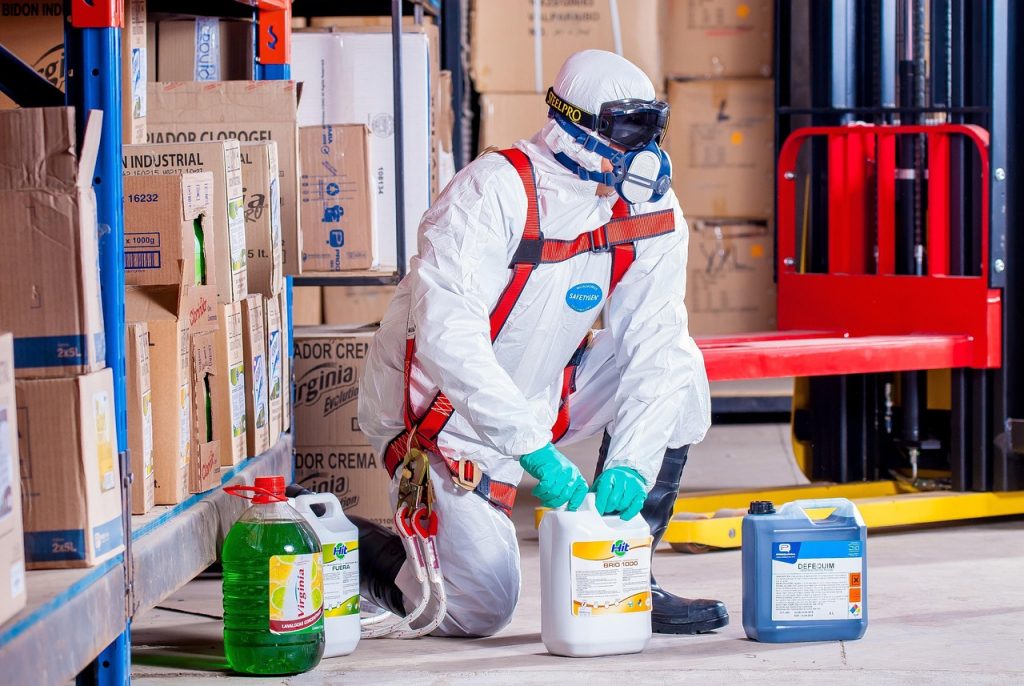
Biohazard removal requires a controlled decontamination sequence to limit exposure and prevent contamination from spreading. Professionals assess the affected area, establish containment, remove hazardous materials, clean surfaces, and verify the results. Negative air systems help control airborne contaminants when the site conditions and hazard assessment require them.
Decontamination Sequence for Biohazard Removal
A structured decontamination sequence separates contaminated work from clean areas and reduces cross-contamination risks. Trained professionals adapt each step to the biological hazard, affected materials, and applicable regulations.
Site Assessment and Containment
The team first evaluates the contamination source, affected surfaces, potential exposure routes, and waste classification. Workers then restrict access, establish clean and contaminated zones, and identify safe entry and exit routes. Appropriate personal protective equipment depends on the hazard assessment.
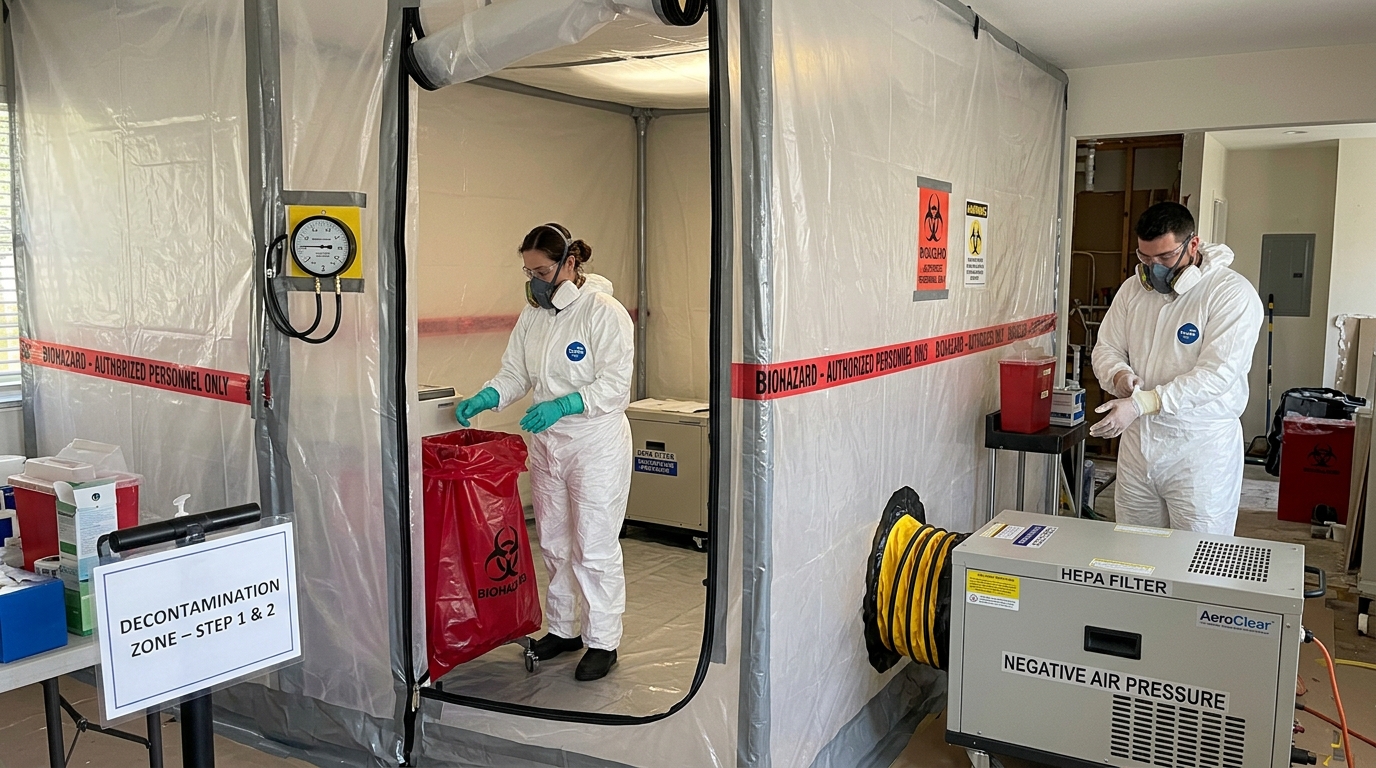
When airborne contamination presents a risk, professionals may establish containment with temporary barriers and a negative air system. They also plan waste handling, emergency procedures, and decontamination arrangements before beginning removal.
Removal, Cleaning, and Disinfection
Workers remove contaminated materials using procedures suited to the hazard and surface type. They place regulated waste in suitable containers and follow applicable transport and disposal requirements. Porous materials may require removal when contamination cannot be safely eliminated.
After removing visible contamination, technicians clean surfaces to reduce organic matter that could interfere with disinfection. They then apply an appropriate disinfectant at the specified concentration and contact time. Staff follow the product label and relevant public health guidance rather than assuming one disinfectant works for every biological hazard.
Final Decontamination and Verification
Before leaving the controlled area, workers follow established procedures for removing protective equipment and managing contaminated tools. They clean or dispose of equipment according to the site-specific plan. Supervisors then inspect treated surfaces and document the work.
Visual inspection alone cannot confirm the absence of every biological hazard. Depending on the incident, verification may involve additional sampling or other professional assessment. The team should only release the area when it meets the applicable clearance criteria.
Negative Air Setup for Biohazard Containment
Negative air systems help prevent contaminated air from escaping a controlled work zone. They use mechanical ventilation to maintain lower air pressure inside the containment area than in adjacent clean spaces.
Equipment and Airflow Control
Professionals select equipment according to the site layout, hazard assessment, containment design, and applicable standards. A typical setup may include an air filtration unit with a suitable high-efficiency particulate air (HEPA) filter, sealed ducting where needed, and pressure-monitoring equipment.
| Setup component | Main function | Key consideration |
|---|---|---|
| Containment barriers | Separate affected and clean areas | Seal openings and potential leakage paths |
| HEPA filtration unit | Captures airborne particles | Select equipment suited to the hazard and required airflow |
| Exhaust ducting | Directs filtered air appropriately | Prevent leakage and avoid unsafe discharge locations |
| Pressure monitor | Tracks pressure differences | Confirm stable negative pressure during work |
| Airflow management | Supports movement toward the work zone | Avoid disrupting containment or spreading contaminants |
| The required airflow and pressure difference depend on the project. Professionals should follow applicable regulations, equipment instructions, and the site-specific containment plan rather than rely on a universal pressure setting. |
Monitoring and Safe Operation
The team checks pressure readings, filter condition, airflow, and barrier integrity throughout the work. Workers investigate unexpected pressure changes, equipment failure, or visible containment damage immediately. If the system cannot maintain safe conditions, they suspend affected activities and restore containment before resuming.
Negative pressure alone does not eliminate biological hazards. Effective control also depends on suitable filtration, correct cleaning methods, protective equipment, and safe waste handling. Some incidents require different controls, so trained specialists must assess the specific risks before selecting a setup.
Conclusion
Biohazard removal depends on a documented decontamination sequence and containment measures suited to the hazard. A qualified biohazard remediation professional can assess the site, establish appropriate negative air controls, and verify that the area meets relevant safety requirements.